NEWS: "... latitude at Harran equals 3/4 atan and at Ur
3/5 atan ..."
2008.04.25 - When is a
"moon temple" an observatory? Recent press reports called my attention
to Göbekli Tepe in Turkey (Göbekli
Tepe
-
An
Introduction). A flurry of news and media has
followed the Jan. 18 Göbekli Tepe article in Science,
319:5861. Location = 37.224 N., 38.922 E.
I particularly enjoyed a blog with good photos and critical attention
to interpretation: My
Visit
to
Paradise.
Since 1994, archaeologist
Klaus Schmidt has excavated at the Göbekli Tepe stone circles,
circles 7,000 years older than Stonehenge. Schmidt reported,
"Gobekli changes everything.
It's elaborate, it's complex, and it is pre-agricultural. That fact
alone makes the site one of the most important archaeological finds in
a very long time." The German
Archaeological
Institute presents information about their Göbekli Tepe
activity online. I include several Göbekli Tepe videos and the
links above for more imagery.
None of us, not even
archaeos, needs an excuse for being unfamiliar with
such early Neolithic megalithic monuments; their existence is still big
news. Nonetheless, interpretations about religion and even Adam and Eve
have appeared. In researching Göbekli Tepe's location, I read more
of the regional archaeological context, with which I'm also rather
unfamiliar. Literally and professionally, I live in the "New World,"
the Americas. One interpretation I encountered online called Harran's
inhabitants "Septimite idolators." Okay then! It was more explicit
associations with astromony that caught my attention with reference to Harran, an ancient
center on the great plain south of
Göbekli Tepe.
Harran is renowned as a
Sabaean center associated with a moon "temple" and as an earlier
Sumerian center. Harran was an important, once-populous prehistoric
crossroad. I noticed Harran's latitude is 36.87 degrees, the acute
angle of a 3:4:5 geodetic triangle (3/4 arctangent = 36.8699°).
Was knowledge of the latitude considered in locating a moon temple at
Harran? When is a "moon temple" an observatory? When is idolatry exact
science?
At this point the Old World
had captured my attention once again, distracting from great pueblo
geometry near the same latitude. The history/myth of Mesopotamia holds
that Ur and Harran are two important, related Sumerian centers, both
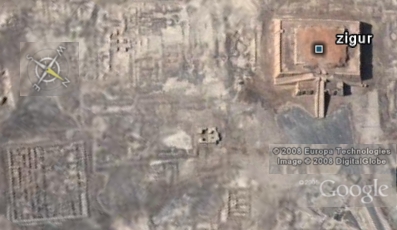
associated with the moon. I checked the Ur ziggurat, at 30.963 degrees.
At first I did not notice colatitude equals 5/3 arctangent (atan).
Colatitude is the distance to the nearest pole, a geodetic reference
point. Latitude references the equator, the mid-poles plane
perpendicular to the rotation axis. The local level plane at Harran
intersects the rotation axis at a 4/3 atan angle, forming a 3:4:5 right
triangle, as does latitude in relation to the equator and geodetic
center.
Summarizing, colatitude at
Harran equals 4/3 atan and at Ur 5/3 atan. Thus, latitude at Harran
equals 3/4 atan and at Ur 3/5 atan. Perhaps these "idolators" were
doing astronomy? Lucky me, astronomy is not punishable idolatry
anymore.
code
site
latitude
longitude
colatitude
harra
Harran
36.8646
39.0312
4/3 atan
zigur
Ziggurat at Ur
30.9627
46.1031
5/3 atan
tgote
Tell Gobekli Tepe
37.2240
38.9225
Getting to why I did not
notice the Ur colatitude right off, I checked latitude first because
the precise value for pi caught my eye in the conversion table. We live
in a 360 degree world, probably due to ancient astronomers in the Sumer
region. Cultures also invent 365 degree worlds, as known from the
history of astronomy in China. Divide earth's circumference by days per
solar orbit (so = 0.98561°), multiply by 10 pi, and the result is
the latitude of the Ur ziggurat (30.9638° = 31.4159 so). This 10x
version of pi caught my eye, distracting from the latitude tangents.
But, I digress with this precise pi coincidence given a 365.25 degree
world.
I turned next back to
Göbekli Tepe and Harran. The sites are apparently intervisible,
just over 40 km apart. The difference in latitude from Harran to
Göbekli Tepe equals precisely 1/1,000 of earth's circumference.
This is where we enter a twilight zone in ancient astronomy. Of course,
the opposite metaphor—"the
dawn" of ancient astronomy, is the proper one regarding the implication. Göbekli Tepe features the oldest
known room aligned north-south, evidence of astronomy in practice.
Even non-archaeos understand
stratification and deposition basics—deeper is older. Göbekli Tepe
is 12,000 years old. Harran is equated with Abraham of biblical fame,
and with Ur of Sumeria, the "Civilized Land" and a "cradle of
civilization." That cradle and astronomy is presumed to be 4,000 to
5,000 years old, not 12,000. Harran is located at 3/4 atan latitude, a
fixed parameter, and Göbekli Tepe is at a specific latitude
difference north. Because the fixed parameter must come first, the
conundrum, of course, is that this precise 1/1,000 of circumference
latitude difference is either coincidence, or ancient astronomy just
took a leap back to 12,000 years ago.
Anyway, that's how I came to
notice the latitudes and colatitudes of Ur and Harran, excitement
enough without entering twilight zones of inference and interpretation.
But if I must, I might argue the Ur and Harran "moon temples" evidence
a relationship to astronomy and precise knowledge of geodesy. In other
words, what we call exact sciences. In videos of
Göbekli Tepe, carved stones speak well enough for themselves
and for their makers 12,000 years ago.
2008.10.13
- Archaeology magazine has a new
Göbekli Tepe article, entitled "The
World's First Temple."
2008.11
- Smithsonsian Magazine has the good sense
to frame same as a question: "Gobekli
Tepe:
The
World's
First
Temple? Turkey's stunning Gobekli Tepe
upends the conventional view of the rise of civilization," by Andrew
Curry with photographs by Berthold Steinhilber.
2009.08
- examiner.com repeats the temple interpretaton in Göbekli
Tepe:
Standing
stones
from
humanity's
oldest
temple by
Gwynneth Anderson. They are engineers when building, "Building such a
site is an engineering challenge...." Then when preserving the
monument, they are religious instead "...worshippers buried
Göbekli Tepe under tons of earth...." Most interesting is the
posted video with numerous still images of the site. The math is fuzzy,
the images are clear:
2010.02.22
- newsweek.com attempts contributing to the interpretation front
in a piece that likely reaches the widest audience so far for the
now-dubbed "... Gobekli Tepe temple near Sanliurfa, Turkey, the oldest
known temple in the world." That is not the only superlative being
thrown about. Patrick Symmes writes "Schmidt has uncovered a vast and
beautiful temple complex, a structure so ancient that it may be the
very first thing human beings ever built. The site isn't just old, it
redefines old...." Not bad for a first building! What Göbekli Tepe
redefines is the depth of our ignorance of our past.
To be fair, I found
Göbekli Tepe news in the article. "Last year Schmidt found his
third and fourth examples of the temples. Ground-penetrating radar
indicates that another 15 to 20 such monumental ruins lie under the
Göbekli Tepe surface." Recent digs uncovered more huge pillars,
now 50, the biggest yet, and what are now the world's oldest
radiocarbon-dated monumental artworks. I was also prompted to check the
Web for new Göbekli Tepe videos, images, and articles, and
far more imagery is online today than a few years ago.
As Göbekli Tepe's
obscurity is displaced by archaeology's limelight, interpretations of
the past will likelier give way to new findings, rather than present
belief systems redefining their own origins in light of deep antiquity
news.
2011.01.29
- Theresa Day writes in Today's Zaman, Göbekli Tepe: Making us rethink our
ancestors, "German
archaeologist Professor Klaus Schmidt ... tells us about site’s
discovery, its importance, what has been uncovered to date ...."
It is satisfying to see the interpretive naming issue addressed:
The press is calling the site the “oldest temple”
in the world, as it dates back to the tenth millennium BC, predating
Stonehenge, for example, by seven millenia. What does Dr. Schmidt
think? “It would be better to call it the ‘oldest yet found and
excavated’ place of cultic activity,” he underlines. “The constructions
at Göbekli Tepe do not satisfy the concrete definition of a
‘temple,’ but the tag ‘oldest temple’ illustrates the site’s standing
in human development quite well.”
... “The major discoveries as a
result of work at the site are the realization that there must have
been a very complex degree of organization in hunter-gatherer societies
and that non-sedentary groups like those were building such monumental
constructions,” he explains.
I recommend the
article. It is obvious the author is an archaeologist sensitive
to interpretive issues. I'm not certain the photo is actually
Göbekli Tepe.
2010.02.22
- Several recent YouTube videos about Göbekli Tepe came to my attention
via Facebook posts. I'm surprised by the amount of utterly
unbelievable pseudo-science now attached to the site. Wildly
fantastic ideation in pop culture and mass media is alarming evidence
of failure of science education. I did a
search of recent videos and found one worth watching without mute, on
the Global
Heritage
Fund YouTube channel.
Meanwhile, the June 2011 issue (219:6) of National Geographic has a lenghty and vividly illustrated Göbekli Tepe article entitled The Birth of Religion. The article begins with the assertion, "Now the world's oldest temple suggests the urge to worship sparked civilization... It is likely noone lived at Göbekli Tepe, a religious sanctuary...." In a National Geographic video, staff artist Fernando Baptista states (translated), "It was the first temple in the world, the birthplace of religion." That sort of grand imagining is simpy not scientific, just fantasy. We know so little of the deep past, such assertions are impossible, patently-false interpretation and an affront to critical thinking. Clay modeling and historical modeling clearly illustrate the difference between empirical evidence and thinking about it.
2011.12.16 -Electrum Magazine published, with good illustrations, Göbekli Tepe’s Oldest Temple in the World – an Archaeological Stone Age Site in Anatolia by Ömer Bülent Sever. For a change, the author, a participant in several excavation campaigns at Göbekli Tepe, reports on the "interpretations" rather than simply declaring the structures to be "temples" instead:
"The stone monoliths of the sanctuary have been interpreted by many historians and archaeologists as the oldest surviving temple in the world."
This article, with detailed descriptions of the site, is a welcome new contribution to popular literature on Göbekli Tepe.
2012.01.06 - A new facet of exploring the past worth a mention is browsing the photographic placemarking layer in Google Earth (GE), the online virtual globe. The application features placemarking "Layers", such as photographic databases. Numerous photographs from many angles allow cyber-explorers to easily envision once obscure ancient monuments. Other useful, visual GE Layers include YouTube and 3D Buildings. For a reference with good links, turn on the Wikipedia Layer.
Once-unknown, mysterious, ancient sites are no longer more-imagined than visible to everyone. Connecting place with data resources, especially with visual arts, is changing how we view the world and civilizations past. Cyberspace today is not unlike a magic carpet ride to anywhere and other times too, as we fly from place to place and from image to image with armchair ease. A lot has changed since Göbekli Tepe came to light, including new high resolution images of the site in Google Earth with the circles visible. Location: 37.22327 N, 38.92235 E.
"Ancient blades made of volcanic rock that were discovered at what may be the world's oldest temple suggest that the site in Turkey was the hub of a pilgrimage that attracted a cosmopolitan group of people some 11,000 years ago."
While it is good to see some skepticism over the "temple" claim, now the idea of pilgrimage has been interjected. I fail to see how trade in tools constitutes a pilgrimage. Has the 'temple' interpretation become so entrenched that trade is seen as pilgrimage, supplanting the possibility that items are traded many times before arriving far from their source? How do initial interpretations influence subsequent ones? At least one caveat accompanies the interpretation:
"Though more research is needed to make any conclusive statements, if the team is right, then Göbekli Tepe was indeed something grand, a place of pilgrimage more than 11,000 years old that attracted people from across the region."
2014.03.09 - NEW:
Göbekli Tepe Newsletter | Deutsches Archäologisches Institut. This year marks the 20th anniversary of archaeological research at Göbekli Tepe.
"... People just love to hear about the biggest, oldest, and most spectacular. And what could be more spectecular than a headline like “The Oldest Temples in the World”? That’s how you sell a find, don’t you? Yet, as scientists we need to show some healthy reservation – in particular when dealing with such phrases and terms which obviously have developed a certain history on their own. It’s all too easy to make up a good story or ‘hypothesis’, but substantiating such proposition is where real research actually starts."
Mesopotamia is located on the fertile
flood plain of the Tigris and Euphrates rivers in a hot desert ecology.
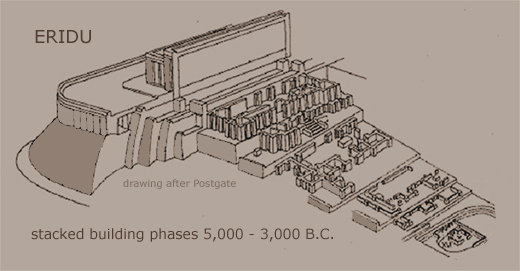
Human settlements based on irrigation agriculture first appeared
coincident to the establishment of Eridu about 7400 BP. A great stepped
tower, a ziggurat, which culminated a series of 20 structures built one
upon another during a span of 3500 years evidences Eridu's importance.
Public architectural monuments were the focus of early Mesopotamian
community centers. By 6500 BP. large scale canal systems and many towns
with public architecture had been founded. Eridu was the largest.
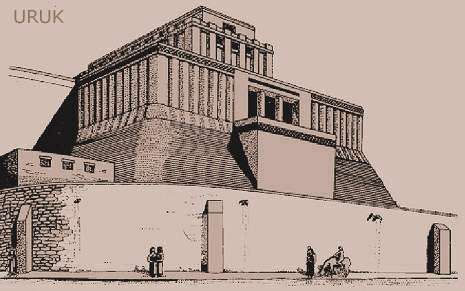
The Eridu period was followed by the
Uruk, named for its largest and most impressive city. Settled by 6000
BP, Uruk grew to a population of 10,000 within a millennia. A
significant number of developments occur in Mesopotamia during the Uruk
period, including increased economic specialization, the introduction
of metals, and use of beasts of burden, the wheel, cart and implements
like the plow. River based exchange networks existed. Uruk's large and
impressive Anu ziggurat was repeatedly enlarged to become Mesopotamia's
largest.
During the dynastic period (5600 - 5100
BP.) a dozen city states evolved coincident with a widespread
abandonment of rural settlement in the region. The population of Uruk
rose to about 50,000 people and sprawled to cover 450 hectares, making
it the world's first known urban center. Defensive walls around urban
concentrations appeared. A significant new development during the
Dynastic period was clay tablets with written script dating to 5,400
BP. A developed system with presentation conventions and 1500
ideographic and pictographic elements evolved. The Sumerian symbols can
be equated with the forms of the earlier token convention dated to
10,000 BP. Writing facilitated cultural continuity, community
organization and commodity transaction. During this period, about 5,000
BP., the first recognizable states appeared.
The innovation of irrigation agriculture
made possible human settlement and population expansion in otherwise
inhospitable areas. Mesopotamia exemplifies this emergent phenomena and
provides one of the earliest case studies of a circumscribed marginal
ecology being transformed into a breadbasket supporting large
population centers. Only the Nile river exhibits a parallel situation
and parallel developments during the same epoch. In Mesopotamia the
earliest period of occupation by irrigation based agriculturalists
centers on Eridu. Previous agricultural communities existed in northern
Mesopotamia where rainfall adequate to support crops and domesticated
animals occurs. What is unique at Eridu and other southern Mesopotamian
settlements is a dependence on canal based irrigation, allowing
emergent agriculturalists to adapt to an otherwise inhospitable
ecology.
Irrigation did occur elsewhere prior to
Eridu's settlement. At Eridu irrigation is a community scale
enterprise. The earliest occupational levels include significant,
central public structures that evolved to ziggurats. These structures
remained central to Mesopotamian communities and are probably
reflective of the evolution of community and regional organization
during a continuum spanning millennia. Their constant rebuilding and
enlargement is indicative of their social significance. Their
centrality in the community is not only spatial; they are surrounded by
important architecture like storage buildings and the most palatial
compounds.
Canal works and public architecture
evidence community organization. Evidence of land control or ownership
systems is more ephemeral. Irrigation works make land more valuable to
the agriculturalist or community, a quality dependent on a capacity to
construct, operate and maintain a spatially complex, elaborate water
transport system. This sort of sophisticated sphere of activity
involves foresight, feasibility understanding, good engineering,
organized construction and, to insure continuity, constant control and
maintenance; in other words a community organization with continuity.
Did communities, families or individuals own the land?
The value added dimension of irrigation
system construction must have altered the way humans interrelated with
land, particularly regarding temporality of ownership. Creators tend to
view their products as property and persons and communities in creating
extensive canal irrigation works became property owners. The ever
larger central mound surmounted with community structures as the locus
of the community area represents a form of deed, evidencing the
community's longstanding claim to the locality. Today the ziggurats,
tells and canal works remain as evidence from which the archaeologist
works to reconstruct how the complex web of the first civilization and
urban area evolved from a highly successful adaptation of irrigation
agriculture.
The combination of agriculture, complex
large scale irrigation works and community organization was such a
successful adaptation that it sustained 50,000 member urban centers.
The massive ziggurats, manifestations of the community's heritage and
enduring temporality, encase many chapters in the history of the
evolution of Sumerian civilization and statehood. Ziggurats, tells,
canals and defensive walls write history for us today as surely as did
the Sumerians evolve to utilize writing, annote our most ancient
histories and thereby begin to close the door on prehistory.
The Original
ArchaeoBlog Pages: Mound Builders of the
Eastern Woodlands, Fall 2005
Due to family, friends,
and students requesting images of my journey
to visit major ancient earthworks in the Ohio Valley region, I started
the
ArchaeoBlog with the following photo galleries. Hopefully, the journals
impart a sense of 'being there now AND long before' while read.