Teotihuacan Mural Art:
Assessing the Accuracy
of its Interpretation
Teotihuacan, the largest city in Mesoamerica during
the Classic period, developed a complex urban civilization. However,
no written histories of Teotihuacan are known, and no true writing system
is apparent. Teotihuacan's artistic tradition used pictorial forms of
visual communication rather than glyphic writing and Teotihuacan art
incorporates standardized glyphic elements (Kubler 1967, Langley 1988).
Even though the Teotihuacanos were familiar with the writing of other
regions, their system does not follow the sequence and glyphic conventions
of depiction seen in the Zapotec and the Maya regions.
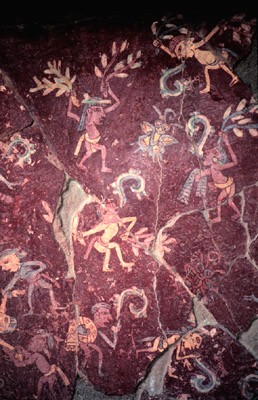 Teotihuacan
has to be reconstructed almost entirely on the basis of its archaeology.
One reason why many aspects of Teotihuacan remain poorly understood
is the fact that a large portion of Teotihuacan remains unexcavated
(Cabrera, et al. 1991:77). The interpretation of the art, iconography
and symbolism at Teotihuacan has remained elusive, or, where proposed,
often there are conflicting interpretations. Interpretation of art influences
contemporary understandings of prehistoric societies and cultures. Accurate
understanding of the mural art of Teotihuacan is integral to a broad
understanding of one of the most influential cultural centers in Mesoamerica. Teotihuacan
has to be reconstructed almost entirely on the basis of its archaeology.
One reason why many aspects of Teotihuacan remain poorly understood
is the fact that a large portion of Teotihuacan remains unexcavated
(Cabrera, et al. 1991:77). The interpretation of the art, iconography
and symbolism at Teotihuacan has remained elusive, or, where proposed,
often there are conflicting interpretations. Interpretation of art influences
contemporary understandings of prehistoric societies and cultures. Accurate
understanding of the mural art of Teotihuacan is integral to a broad
understanding of one of the most influential cultural centers in Mesoamerica.
This paper focuses on issues related to the assumptions
and validity of mural art interpretation. First, to provide some context
for the discussion, I briefly describe Teotihuacan mural art, discuss
the current understanding of mural chronology, and outline the history
of its study. I then consider issues relating to interpretation. A discussion
of the full range of specific mural interpretations would be an enormous
task, and is unnecessary to address the issues herein. I decided to
discuss a specific theme, that of the interpretation of religion, to
illustrates questions about accuracy of interpretations. In the final
major section I discuss the interpretation of religious themes, first
by focusing on broad religious interpretations, then by presenting specific
elements and categories of the art with religious interpretations.
TEOTIHUACAN MURAL ART
One of the impressive features of Teotihuacan is the
polychrome mural art, some surprisingly well preserved. The mural art
constitutes a significant data source with respect to Teotihuacan culture.
Mural painting and ceramics are the principal surviving art forms at
Teotihuacan, and murals are an important aspect of its architecture.
The great number of known murals at Teotihuacan is illustrative of their
importance. Most of the murals were painted on a plaster medium, a medium
with good preservation, with a true fresco technique (Littmann 1973:175).
Due to their greater preservation, paintings from lower walls are better
known.
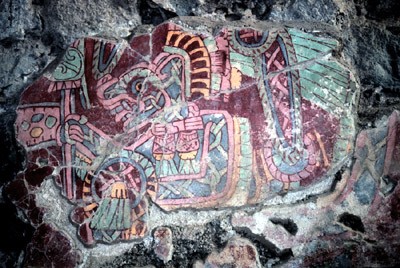
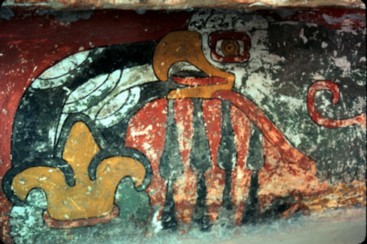 Teotihuacan
mural art is characterizable as pictographic visual communication. There
is a great diversity in the complexity and kinds of signs used in the
mural art, varying from naturalistic to geometrical, to abstract. Depictions
include quetzals, jaguars, doves, fish, felines, serpents, shelled animals,
shells, sea creatures, water lilies, and seeds. Flowers, shells, and
feathers abound, as does the depiction of humans, animals, and compound
forms, while utilitarian objects and domestic scenes are rare (Langley
1986:31). The art includes stylized representations based on living
organisms found in the natural world. Anthropomorphs and animals can
be composites and there are also compound forms with no actual correspondence
to nature. Many signs are surrounded by concentric borders and create
the effect of cartouches. Teotihuacan
mural art is characterizable as pictographic visual communication. There
is a great diversity in the complexity and kinds of signs used in the
mural art, varying from naturalistic to geometrical, to abstract. Depictions
include quetzals, jaguars, doves, fish, felines, serpents, shelled animals,
shells, sea creatures, water lilies, and seeds. Flowers, shells, and
feathers abound, as does the depiction of humans, animals, and compound
forms, while utilitarian objects and domestic scenes are rare (Langley
1986:31). The art includes stylized representations based on living
organisms found in the natural world. Anthropomorphs and animals can
be composites and there are also compound forms with no actual correspondence
to nature. Many signs are surrounded by concentric borders and create
the effect of cartouches.
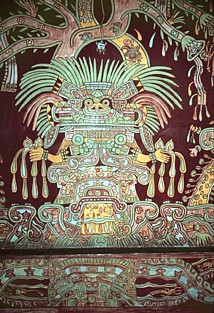
Some pictographic signs represent natural objects and
function nominatively while others are associated with activities. In
the Temple of Agriculture mural small human figures are depicted presenting
items to two composite mountain-platform forms which are anthropomorphized
with earplugs, necklaces and nose plugs. Settings such as this have
been interpreted as ceremonial and ritualistic. Other murals have a
playful quality.

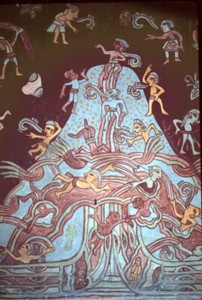
Tepantitla recreation in the National Museum of Anthropolgy, Mexico,
D.F.
Sound scrolls, from simple spirals to complex compound
scrolls with bordering and enclosed signs, emanate from beings and natural
objects, including shells. Streaming motifs, decorated like the sound
scrolls, emanate from the mouths of creatures and fall from the hands
of people and anthropomorphic forms. Insignia such as rattles, bags,
standards, headdresses and shields are used in the composition of anthropomorphic
forms. Individual attributes such as rank, function, and affiliation
may have been recorded, and persons and places were probably named (Langley
1986:174).
DATING THE MURAL ART
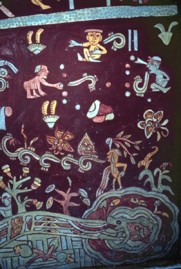 Although
early and late murals can be distinguished, a refined chronological
sequence for the murals does not exist (LaGamma 1991:275). Several
authors offer varying dates for the murals. Lombardo (1996) recently
offered a five-phase stylistic sequence. According to Lombardo (1996:5),
the earliest known mural painting in Mesoamerica occurs after 100 A.D.
Early mural art was decorative and geometric. In general, the murals
rendered in red colors are considered older than the polychrome murals
(Cabrera 1995a:xxviii). Miller (1973:12) writes that mural painting
began at least as early as 200-300 A.D. and continued until about 650
A.D., with the majority of mural art dating from 450 to 650. LaGamma
(1991:275) states that mural painting began around A.D. 250 and reached
its major florescence during the period 600-750 A.D. Concentric circles
and marine shells painted on the facade of the Feathered Serpent pyramid
probable date to between 100-200 A.D. (López,
et al., 1991:93, Cabrera 1995b:7). Although
early and late murals can be distinguished, a refined chronological
sequence for the murals does not exist (LaGamma 1991:275). Several
authors offer varying dates for the murals. Lombardo (1996) recently
offered a five-phase stylistic sequence. According to Lombardo (1996:5),
the earliest known mural painting in Mesoamerica occurs after 100 A.D.
Early mural art was decorative and geometric. In general, the murals
rendered in red colors are considered older than the polychrome murals
(Cabrera 1995a:xxviii). Miller (1973:12) writes that mural painting
began at least as early as 200-300 A.D. and continued until about 650
A.D., with the majority of mural art dating from 450 to 650. LaGamma
(1991:275) states that mural painting began around A.D. 250 and reached
its major florescence during the period 600-750 A.D. Concentric circles
and marine shells painted on the facade of the Feathered Serpent pyramid
probable date to between 100-200 A.D. (López,
et al., 1991:93, Cabrera 1995b:7).
Of the great quantity of murals so far discovered at
Teotihuacan a few are approximately dated by inference from the dating
of the buildings where they are found (Cabrera 1995a:xxvii), although
the majority of the buildings do not have a precise date (Cabrera 1992:113).
Miller (1973:37) thinks the murals and walls were made at approximately
the same time; that the murals were created at the time of construction,
that the architecture is patterned to display the paintings, and that
the paintings give meaning to the architecture. On occasion murals were
plastered over and replaced with new paintings (Miller 1973:37). The
murals in the Patio Blanco of Atetelco are dated to 350-450 A.D., and
the other Atetelco murals dated to between 450 and 650 A.D. (Cabrera
1995a:xxvii).
A BRIEF HISTORY OF MURAL STUDIES
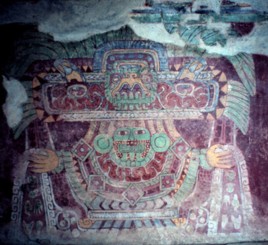 Murals
were first excavated by Batres in 1883 (Miller 1973:13). The discovery
of the dynamic Tepantitla murals in 1942 stimulated renewed interest
in the mural art (Miller 1973:13). Excavations were started at Tetitla
and Zacuala in 1944, and at Atetelco in 1945 (Miller 1973:13). Villagra
restored murals at Atetelco (Villagra 1951). Séjourné
(1959, 1966) studied both Tetitla and Zacuala. During the 1960s numerous
new murals were uncovered by the excavation and restoration programs
of the Instituto Nacional de Antropología e Historia (Miller
1973:13). The newly discovered murals resulted in numerous mural studies. Murals
were first excavated by Batres in 1883 (Miller 1973:13). The discovery
of the dynamic Tepantitla murals in 1942 stimulated renewed interest
in the mural art (Miller 1973:13). Excavations were started at Tetitla
and Zacuala in 1944, and at Atetelco in 1945 (Miller 1973:13). Villagra
restored murals at Atetelco (Villagra 1951). Séjourné
(1959, 1966) studied both Tetitla and Zacuala. During the 1960s numerous
new murals were uncovered by the excavation and restoration programs
of the Instituto Nacional de Antropología e Historia (Miller
1973:13). The newly discovered murals resulted in numerous mural studies.
Von
Winning, beginning in 1946, studied and reported on specific depictions,
dripping water, shell designs, building representations, figurines, the
reptile eye glyph, and he offered interpretations. He approached the
art by examining motifs for detailed comparative study (Kubler 1967:3,
von Winning 1987). Séjourné (1959, 1966) produced several
works on Teotihuacan art and architecture containing very useful drawings
and photographs. Her "psycho-historical method" (Kubler 1967:3)
focused on attempting to find a unitary key to interpretation of cultural
symbolism. Pasztory characterized Séjourné’s view
as mystical and meditative. Caso studied Teotihuacan glyphs (1942, 1958-59,
1961) and, in particular, addressed glyphs related to calendars (1937,
1967). In 1966 he published an article on the gods and symbols at Teotihuacan.
 Kubler
(1967), in a brief article, attempted to define iconographic relationships
in Teotihuacan art, describing configurations and their internal relationships.
Kubler characterized Teotihuacan iconography as word pictures and used
a linguistic model to consider the relationships of pictographic elements.
He reported 55 images of life forms and 50 glyph signs. He stated that
most of the signs also occur in Vera Cruz, at Monte Albán, or at Xochicalco, that some appear at Tikal and
Kaminaljuyu, and that some signs are peculiar to Teotihuacan alone.
In Kubler’s view the artists at Teotihuacan were "less interested
in recording appearances than in combining and compounding associative
meanings in a quest for viable forms of writing" (Kubler 1967:5). Kubler
(1967), in a brief article, attempted to define iconographic relationships
in Teotihuacan art, describing configurations and their internal relationships.
Kubler characterized Teotihuacan iconography as word pictures and used
a linguistic model to consider the relationships of pictographic elements.
He reported 55 images of life forms and 50 glyph signs. He stated that
most of the signs also occur in Vera Cruz, at Monte Albán, or at Xochicalco, that some appear at Tikal and
Kaminaljuyu, and that some signs are peculiar to Teotihuacan alone.
In Kubler’s view the artists at Teotihuacan were "less interested
in recording appearances than in combining and compounding associative
meanings in a quest for viable forms of writing" (Kubler 1967:5).
C. Millon, in an article on the
history of Teotihuacan mural art (1972:2), characterized the "more than 200 mural paintings
from 40 structures" then known as "a very small sample of
the paintings." She wrote (1972:1), "To try to understand
the history and way of life of Teotihuacan without careful study of
the mural painting would be equivalent to study of the Maya area without
its sculptures or its codices." She also pointed out the size and
complexity of the city, the diverse functions of painted structures,
the possible great variation (ethnically, in status, and in occupations)
in art patrons, the public and private settings of the art, and the
possible differences in belief systems (C. Millon 1972:2). She noted
that mode of expression through time changed "radically,"
and concluded "whether its import changed as well we may never
know." She (1973) also studied the "tasseled headdress" and offered
the interpretation that political and religious leadership were united.
INTERPRETATION OF THE MURAL ART
 Authors
disagree on the interpretations of Teotihuacan art, on the degree of
decipherment that is possible, and on methods. For example, a glyph
with dots (interpretable as numerals at Teotihuacan) is interpreted
as a heart with blood by Séjourné, as drops
of water by Von Winning, and as a calendar sign by Caso (1967:175).
More examples of contrariety in interpretation are presented in the
discussions below. Authors
disagree on the interpretations of Teotihuacan art, on the degree of
decipherment that is possible, and on methods. For example, a glyph
with dots (interpretable as numerals at Teotihuacan) is interpreted
as a heart with blood by Séjourné, as drops
of water by Von Winning, and as a calendar sign by Caso (1967:175).
More examples of contrariety in interpretation are presented in the
discussions below.
Acosta stated that he was somewhat fearful of making
interpretations of the mural art in the Quetzalpapalotl Palace because
it is very easy to give a seemingly normal and believable explanation
to the mural art, even if that interpretation has no scientific basis
(Acosta 1964:48). Acosta (1964:48) wrote:
"No es que estemos en contra de hacer interpretaciones,
pero siempre y cuando éstas no pertenezcan al mundo de la fantasía.
Sin duda, la obligación de todo investigador es presentar
una tesis interpretativa al finalizar sus exploraciones, más
debe de proceder con cautela porque una afirmación equívocada
puede retrasar las investigaciones indefinidamente."
Morelos (1991) addressed interpretation issues at length,
writing in parts:
"es común observar trabajos donde los
autores sostienen que realizan un estudio sobre las costumbres religiosas
de una cultura, cuando en realidad de manera comparativa están
imponiendo, a ciertos elementos de las obras, contenidos simbólicos
diversos." (Morelos 1991:233)
"La más de las veces el estudio ... se
hace a partir de la ‘imaginativa sospecha’ del investigador,
en donde la mayoría de las proposiciones si no son reiterativas
y comunes caen en teorizaciones muy vagas." (Morelos 1991:233)
"...existen tres tendencias evidentes: la primera
y más común es la comparativa, que se realizan con las
representaciones y las obras mexicas ... la segunda se inclina por
describir con cierta minisculidad las obras para que a partir de esto
se formulen interpretaciones sobre el tema o las formas observadas
que en la mayoría de los casos no sobrepasan el nivel descriptivo
original; la tercera pretende realizar un análisis integral
con el desarrollo social, pero al carecer de una propuesta teórica
general sobre la sociedad teotíhuacana, es común que
se expongan conclusiones que resultan inversosímiles." (Morelos
1991:233-234)
"En arqueología hay cierta preocupación
por establecer criterios, postulados teóricos y métodos
que permitan que las investigaciones tengan cierta rigurosidad científica
para una gran varidad de materiales. Sin embargo en lo que respecta
a las obras o manifestaciones artísticas ... hay por lo general
cierta liberalidad que ocasiona confusiones ya que permite la coexistencia
de explicaciones muy diversas." (Morelos 1991:238)
Various sciences, their diverse
schools of thought, and the diverse areas of the humanities can have
distinct views of art. Morelos (1991:238) views five orientations in
the investigation of prehispanic art: 1.) the romantic or idealistic
view, which considers the content as elevated spiritual material of
a religious, magical or mythical nature, 2.) studies that pretend that
imaginative deductions and sterile theories are "absolute truths," 3.)
historical studies that remove exceptional cultural success from its
socioeconomic context, 4.) views that attempt to explain, rather than
catalog, isolated aspects grouped by an iconographic criterion, and
5.) studies that lack a fundamental methodology.
 Interpretation
of Teotihuacan mural art certainly presents difficulties. Symbols, and
even naturalistic depictions, may or may not have particular meanings.
Phonetic or logographic readings and rules of syntax of Teotihuacan
graphic representation have not been elucidated. At Teotihuacan, without
a knowledge of the language(s) spoken, the glyphs cannot be readily
subjected to a philological test and metaphorical understanding is entirely
lacking. The lack of linguistic knowledge is a major impediment to the
interpretation of the notation (Langley 1991:295). With iconographic
analysis, rather than epigraphy, there are no certain literal meanings. Interpretation
of Teotihuacan mural art certainly presents difficulties. Symbols, and
even naturalistic depictions, may or may not have particular meanings.
Phonetic or logographic readings and rules of syntax of Teotihuacan
graphic representation have not been elucidated. At Teotihuacan, without
a knowledge of the language(s) spoken, the glyphs cannot be readily
subjected to a philological test and metaphorical understanding is entirely
lacking. The lack of linguistic knowledge is a major impediment to the
interpretation of the notation (Langley 1991:295). With iconographic
analysis, rather than epigraphy, there are no certain literal meanings.
There is a significant variation
in the rendering of most signs, even though the signs have prototypical
forms (Langley 1986:17). The time depth of sign usage is uncertain,
and continuity of usage can be unclear. As seen above, in the previous
section, mural chronology is not refined. Without a reliable chronology
comparisons of motifs in different murals lack temporal determinations.
Even if temporal relationships were known, the question, "Can context of a motif in one mural
be used to determine meaning in another mural?" remains (to say
nothing of its presentation in other media, sites or cultures). I have
noticed a general tendency in mural studies (and Mesoamerican art studies
generally) of treating the mural art as though it is a unified whole,
rather than myriad artworks by numerous artists spanning many centuries.
While there are components of the art that obviously adhere to definable
conventions, motifs may be used in contexts that are not part of a symbolic
system. There is no certain criterion to delimit these domains.
Teotihuacan art has been termed more abstract, conceptual
and possibly allegorical than other Mesoamerican art, and difficult
to interpret (Pasztory 1988:46). Compound forms present more difficult
interpretive questions than single motifs. Langley writes:
"although the individual
signs may be drawn from nature, it is often difficult to determine
even the literal meaning of compounds. This is in part due to the
uncertainty about what precisely the artist wished to invoke by certain
pictographic images ... the messages they are intended to express
often remain obscure. (1986:41-42).
While these many problems exist, I find other factors
to be supportive of the view that interpretation is plausible. Langley
believes that Teotihuacan art includes a more complex and effective
system of symbolic notation that previously recognized (1991:286). Patterns
of sign and context association suggest the existence of rules of composition
and display the characteristics of systematic usage (Langley 1986:173-174).
A degree of heterogeneity of Teotihuacan signs is obvious (Langley 1991:294).
Signs cluster with a limited range of other signs and with certain contexts,
there is a great deal of repetition in the clustering of the signs and
contexts, and there is minor variation within the patterns of association
(Langley 1986:173). Of course, proof that the patterns of sign usage
are part of a notational system depends on interpretation of their meanings.
In this regard Langley writes:
"A safeguard against error or worse--the fictive
interpretations that have plagued the study of early writings--lies
in the demonstration that the semantic values of signs remain the
same throughout the corpus or that variations are explicable in philological
terms." (Langley 1991:294)
The limited, identifiable categories of representation
are useful in interpretations and the delineation of conventions. One
such classification, by Miller (1973:19-23), divided the mural elements
into nine composition categories:
1.) processional profile figures,
2.) frontal or head-on figures,
3.) central frontal figure with confronting profile figures on either
side,
4.) scenes,
5.) heraldic images,
6.) natural motifs,
7.) ritual paraphernalia,
8.) geometric and curvilinear designs,
9.) architectural motifs.
Cross-cultural comparisons and analogies
within Mesoamerica are possible. The cultures of Mesoamerica shared
a mutual history, a calendar, and, to a degree, "certain basic religious and mythological
beliefs" (Pasztory 1976:110), although I question the accuracy
of contemporary interpretations of those beliefs. Prior to Teotihuacan
art, Olmec artistic representations, elements of which are recognizable
in Teotihuacan murals (Lombardo 1996:13-15), evidenced conventionalized
ideographic elements over a wide geographic region. And broad continuities
are seen between Teotihuacan and contemporaneous groups, as well as with
Aztec symbolism. However, this approach has limitations.
 The
direct historical approach to interpretation of Teotihuacan art by analogy
with Aztec art began before the temporal gap between the artwork of the
two cultures (at least 700 years) was fully appreciated. In her interpretation
of some Teotihuacan murals, Séjourné used
analogies to interpretations of Aztec art. Séjourné (1959)
viewed Teotihuacan as the place of origin of Nahuatl religion and its
art as "una escritura santa," and she interpreted anthropomorphic
figures in the mural art as the nearest perceived equivalent numen in
Aztec art (1959:30). For example, Séjourné equated a female
representation at Teotihuacan with the Aztec representation of Chantico
(1966:152). The
direct historical approach to interpretation of Teotihuacan art by analogy
with Aztec art began before the temporal gap between the artwork of the
two cultures (at least 700 years) was fully appreciated. In her interpretation
of some Teotihuacan murals, Séjourné used
analogies to interpretations of Aztec art. Séjourné (1959)
viewed Teotihuacan as the place of origin of Nahuatl religion and its
art as "una escritura santa," and she interpreted anthropomorphic
figures in the mural art as the nearest perceived equivalent numen in
Aztec art (1959:30). For example, Séjourné equated a female
representation at Teotihuacan with the Aztec representation of Chantico
(1966:152).
Kubler rejected the use of analogy between Aztec and
Teotihuacan art, warning that over long spans of history disjunctions
of form and meaning may be expected more often than continuity in their
associations (Kubler 1967:12). More recent authors, among them Cowgill
and Berlo, have also commented on this issue:
"Aztec society was very different from that of
Teotihuacan in many respects. Nevertheless, it is increasingly clear
that there were many broad continuities ... Obviously we must be careful,
look for specifics more than generalities, and be sensitive to differences
as well as resemblances." (Cowgill 1992:231)
"Until recently, a reductive rather than
a deductive method has been used when applying Aztec sources
to the study of Teotihuacan divinities." (Berlo 1992:130)
Some very broad issues and theoretical problems came
to mind while I read the mural literature. Fundamental questions seem
to have been ignored in the study of Teotihuacan mural art, and unstated
theoretical assumptions seem prevalent. I believe it is valid to assume
that the world view of a society, whether those views are religious,
magical, mythical, natural, scientific or combinations of these, will
be inherently evidenced, at least to some extent, in its symbolic system.
Contrarily, I regard as invalid the assumptions that only one world
view exists in a society, that world views are consistent over the temporal
span of a society, or that one or the other of the possible world views
(i.e. religious) is inherently present.
Before, or as a part of, interpreting
a society’s
art the following fundamental questions need to be addressed. To what
extent was the symbolic system interrelated with particular arenas of
the social system, with the arts, entertainment, social life, production,
politics, religions, or other arenas? What evidence, outside of the
interpretation itself, supports the relationships and meanings posited?
Different groups in a society may have entirely distinct world views,
especially in a large and complex urban civilization such as Teotihuacan.
Did the symbolic system serve to reproduce the philosophy, customs,
beliefs, social norms and ideologies of the society at large or particular
groups, and if so how extensively and/or exclusively? Does all the art
adhere to a symbolic system, or is only a portion of the art systematic?
Is the art, and its components, the product of individual consumer’s
and/or artist’s taste in decoration, or is it governed by a communal
aesthetic? Who controlled the content of the art? In my view, the interpretations
discussed below disregard these questions and theoretical issues.
At the opposite end of the spectrum,
that is, the specific, I also question certain interpretations and
their underlying assumptions. For example, some quite simple geometric
decorations have been interpreted as inherently meaningful. As Cabrera
(1995d:46) reports, green circles have been interpreted as "chalchihuites,
símbolos
de belleza, los objetos preciosos, el campo verde, la abundancia, la
fertilidad." Also Cabrera (1995d:47) himself interprets circular
red drawings with fringes (in Portico 2, Conjunto Plaza Oeste) as shields
which warriors carry, and triangles in a series on either side of parallel
lines as "macanas o armas militares" (clubs), in part because
they are opposite the portico with the fringed circles (1995d:48). While
some of these interpretations might be true, geometric forms can also
simply be decorative. In the case of these examples, the motifs lack
contextual support for the interpretations. As in these examples, interpretations
often assume that complex meaning is inherent in the most basic motifs,
or that every design, even the most ubiquitous of geometric forms, is
part of a symbolic system. This case, that of assumptions in interpretation
of simple geometric forms, exemplifies a more complex problem of assumptions
when considered in relation to more complex motifs.
RELIGIOUS INTERPRETATIONS
The following discussion focuses on the motifs and categories
that have been interpreted as religious. I first present some general
interpretations by diverse writers, and then discuss specific categories
and elements. When they are offered in the literature, and this is not
always the case, I include the rationales for the interpretations. My
purpose is to present sufficient material to assess the religious interpretation.
The various interpretations are not consistent; the authors are not
always in agreement. This variability certainly justifies questions
about the accuracy of the interpretations. Several authors make very
broad assumptions about religion and Teotihuacan.
R. Millon argued that Teotihuacan:
"was a sacred place of enormous prestige, whose
religion must have encompassed a belief system that transcended ethnic,
linguistic, and regional ties." (1992:378).
Cabrera, et al., (1991:78) wrote:
"...religion undoubtedly
was of enormous importance throughout the life of the city...."
Angulo (1996:134-135) plainly states his assumptions
about Teotihuacan religion as follows:
"La proposición para entender el pensamiento
cosmogónico en la etapa teotihuanaca que aquí se aplica,
se basa en la consideración que desde la fase inicial todas
las culturas prehispánicas compartían un concepto mítico
acorde con una religión politeísta que deificaba a todo
elemento natural."
An underlying assumption of "divinities" is
apparent in Berlo’s (1992:129) comment, ironically, about how much
remains unknown about Teotihuacan images:
"For more than a century, Teotihuacan’s
images and icons have been the object of scholarly scrutiny. Yet
major questions about the nature of the image system, the divinities
portrayed, and the uses of art at this great metropolis remain unanswered."
Kubler (1967:5-6) interpreted the
mural scenes at Zacuala as strongly suggesting litany and liturgy,
including the names of deities, recital of the powers of the deity,
and worshiper’s petitions.
He suggested (1967:6) that the murals designate "complex liturgical
comparisons, where powers, forces, and presences are evoked in metaphors
or images", and concluded (1967:12) that "every mural or decorated
vessel is a prayer exalting the elements of nature."
While earlier scholars described the Teotihuacan mural
art as primarily religious and ritualistic, Langley (1986:11) found
considerable evidence suggesting a broader range of information. He
(1992:275) stated that social concepts like religion and sacrifice could
be expressed by the Teotihuacan sign system:
"...we can be confident that emblems of
various kinds were widely used in the culture, that sign usage included
the arrangement of signs in linear sequences characteristic of verbal
texts, and that the sign system was capable of signifying concepts
such as war, sacrifice, and, probably, ritual events."
Langley (1992:257) blended martial and religious interpretations:
"In considering all the analogies
cited and the imagery of the Teotihuacan insignia there seems no
doubt that they may be comprehended as emblems of military leadership
related to the Storm God, implying that this deity was, inter alia,
the patron of the warriors who fought under his insignia, much as
the Crusaders a few centuries later sailed for the Holy Land under
the banners of Christ."
Pasztory states that the signs, as defined by Langley
"are related to deities, mythological animals,
and human or animal-human composites dressed either as warriors or
priests." (Pasztory 1988:70)
Pasztory sees the art of Teotihuacan
as concerned with human, social, and political relations, as well as
cosmic relations that denote the human place in nature, in the universe,
and "in
relation to the gods" (1991:247). She wrote:
"...nature, fertility, sacrifice, and
war, ... are seen as a collective enterprise in which humans, animals,
and even gods are depicted..." (1992:136).
"Teotihuacan images suggest a neutral, impersonal
world inhabited by largely benevolent deities and by an anonymous
elite preoccupied with the proper performance of ritual." (1992:137).
Interpretations of specific elements or scenes are easier
to analyze than broad and sweeping general interpretations. They are
also the foundation of broader interpretation (or, at least, they should
be) and, if unjustified, raise questions about broader interpretations.
In the remainder of this section I focus on specific interpretations.
One such interpretation is the attribution of religious
meanings to simple geometric forms. Basic geometric forms are found
in the art and decoration of many cultures, and cannot be justifiably
interpreted as religious without supportive evidence. The limited geometric
designs of the earliest Teotihuacan stylistic phase; circles, various
forms of frets, undulating bands, interlaced volutes, a U-shaped glyph,
vertical bands and the movement glyph, are interpreted by Lombardo as:
"Cada uno de estos elementos simbólicos
funciona en el contexto ritual como indicador mnemotécnico,
que remite al orante a la plegaria, repetida el número de veces
necesario para que surta el efecto mágico religioso." (1996:21)
Lombardo (1996:13) interpreted pictographic
images in Guerrero in "estilo llamado ‘olmeca’" as
signifying an agrarian society deifying natural forces and developing
a culture to control them through magic and religion. Lombardo (1996:21)
states her assumption, regarding concentric circles and continuity
of iconography, as follows:
"Los circulos concéntricos
o anillos, por su permanencia en casi todas las culturas posteriores
del Altiplano mexicano, se asume que representan cuentas, joyas, chalchihuites, que
por asociación se les identifica con la función
calificativa de ‘lo precioso’, ‘lo valioso’. Cuando
son verdes y semejan jade o serpentina --piedras que desde el Preclásico
se utilizan en rituales y cultos-- se relacionan con el agua, con las
gotas de lluvia y por lo tanto con la fertilidad."
In this case both of the interpretations of Aztec art
are seen as having a continuity of meaning spanning over two millennia.
A subtle form of interpretation
is the nomenclature of structures and murals reflecting religious interpretations.
This presents the question, "How does the interpretation of functions
of structures influences interpretations of their murals?" (and
vice-versa). The ‘Temple’ of Agriculture is an often-interpreted
example of early murals with scenes. A scene excavated by Batres is
called the "Offering Scene Mural." Berlo (1992:133) proposed
the following interpretation of the scene:
"In the Temple of Agriculture
mural, the goddess is depicted as monumental mountain-like forms
in relation to her worshippers."
Regarding the same mural, de la Fuente (1995b:107) wrote:
"Ésta se ha llamado de ‘las ofrendas’
porque las acciones ahí representadas sugieron que los personajes,
sentados y de pie, ofrecen distinctos dones de la tierra a dos grandes
imágenes que se han interpretado como deidades, como braseros
con flamas, y también como construcciones en cuyo interior
hay un sahumerio con flamas. Los supuestos ofrendantes llevan palomas,
maiz, y otros objetos, y entonan oraciones o cantos según se
apreciaba por las vírgulas del lenguaje que salían de
sus bocas."
Regarding the shells mural in the complex, de la Fuente
(1995b:104) adds:
"...al centro el la parte
alta una especie de tocado, que recuerda a otros que se miran en
varios imagenes teotihuanacas, y que pudieron simbolizar la imagen
de una deidad..."
These examples raise questions about
a broad category of interpretation, "Are gods and priests depicted in the art?"
There are several expressed interpretive criteria for identification
of deities and/or priests. According to LaGamma (1991:282) "...frontal
depiction is a sign of divinity at Teotihuacan..." Kubler wrote
that "the detailed meaning of the art of Teotihuacán remains
a mystery," yet he interpreted anthropomorphic motifs as priests
(Teopancaxco mural), warriors (Atetelco murals), or representations
or impersonations of deity, all by reason of their wearing or bearing
attributes such as butterfly wings, a conch (Atetelco), or an animal
helmet (1967:3-4). Kubler suggested that frontal figures may have more
rank than profile figures because they are generally larger and more
elaborate, and are frequently flanked by profile figures (1967:7). Kubler
(1967:7) concluded that "frontal representations probably describe
cult images" and that:
"the hypothesis that many
frontal figures are cult images or supernatural beings allows us
to suppose that the same figures, when shown in profile ... represent
human celebrants, or priests, or impersonators."
Angulo (1996:140) summarized the distinguishing characteristics
of a priest depiction as follows:
"Hay varias figuras antropomorfias que llevan
los mismos atributos o emblemas que characterizan a las deidades,
aunque es fácil distinguirlas de ellas, por estar representadas
de perfil y de cuerpo entero, a la vez que por encontrarlas ejerciendo
algún ritual en torno a la deidad que representa de frente
o como un busto solo."
The interpretation of profile figures
as priests is also seen in Cabrera’s reference (1995e:157-158)
to the Teopancaxco murals:
"En una composición simétrica,
se muestran de perfil dos sacerdotes que se dirigen hacia un pequeno
altar sobre el que se levanta un disco solar."
Barthel (1982:4) wrote:
"Depictions of Teotihuacan
deities and priests are distinguished by a large volute emanating
from the mouth (speech or chant scrolls) and by open hands casting
offerings."
Figures with a falling stream from
their hands have been interpreted as elites and as deities. Pasztory
(1992:142) discussed her interpretation of the symbol’s purpose:
"A primary Teotihuacan symbol
is the divine hand from which water, seeds, jades, or other gifts
flow. This theme is ... evident in ... various abstract and metaphoric
symbols painted in repeating series on polychrome mural panels. Such
images are positive reinforcements: they emphasize the beneficial
aspects of gods, nature, and elites, and thus, presumably, encourage
an easy adherence to the norms and traditions of society."
Ostrowitz (1991:266) suggested that images with faces
are easier to associate with deity:
"Images of natural forms organized around
a center are easier to associate with a deity or an anthropomorphic
being when a face is included in the composition. The face suggests
an expression of consciousness, a mind --or will-- that elevates the
otherwise blind natural forces operating through the medallion to the
level of intentional behavior."
Ostrowitz (1991:263) also suggested that elements in
murals that seem to float are supernaturals. This conclusion apparently
assumes that elements in Teotihuacan art are subject to the physical
law of gravity.
"Because the portrayal of
nature by Teotihuacan artists is persistently organized according
to particular canons of representation, the paintings contain a certain
objectivity, or actual existence in a distinct but credible reality.
"...the murals function effectively
as windows onto a consistently configured but unique physical plane
that follows bona fide laws of its own....
"Certain free-floating medallions in this painted
world, unfettered by the constraint of gravity, may constitute key
structures that signify the presence of a supernatural being....beings
operating outside the ‘laws of nature,’ ones defying gravity..."
Some interpretations include some
very specific assertions and hypotheses about the identity of deities.
Peter Furst suggested a "Mother Goddess" as the principal deity (1974:198). Séjourné
(1966:248), based on ear ornaments in an Aztec depiction interpreted
as a goddess, interpreted a Tetitla mural personage as a feminine deity.
Pasztory interprets representations to include the Storm God and her
"Great Goddess," a major personage in murals and possibly
"the major deity" during the Metepec period (Pasztory 1988:74).
C. Millon (1988:228) wrote:
"The Great Goddess was one
of the most powerful Teotihuacan deities, perhaps for a time the
most powerful. Like the Storm God she manifested herself variously
in different roles and different contexts. It is more accurate to
speak of a Great Goddess complex. We do not know to what degree her
different personalities may have been regarded as distinct entities."
Pasztory (1992:141-142) wrote, :
"Both the Storm God and the
Great Goddess appear to have military or destructive aspects, and
other deities, including one wearing an owl pendant, may have been
related to war."
LaGamma (1991:282) wrote:
"The Great Goddess’s facelessness in so
many representations --in some instances her face is concealed by
a mask and in others she is represented only by a headdress-- allows
her to display an especially wide range of aspects. In other murals
the Great Goddess displays the jaguar’s ferocious teeth, and
her hands are replaced by claws. Her innate flexibility would enable
her to exchange her mask for a jaguar face, and the jaguar could be
seen as a surrogate for a particular aspect of the Great Goddess."
R. Millon (1992:359) summarized the Great Goddess as:
"a goddess of earthly waters, a patroness
of warfare who requires sacrifices, mother of the gods, and the fertile
mountain from which all things come."
The category "processional figures’"
as the name implies, has been interpreted as religious. Seler interpreted
processional figures as priests in 1915 (Pasztory 1976:113). Pasztory
(1976:112) interpreted three kinds of processional figures, warriors
(figures carrying weapons), priests (those carrying bags), and gods
(human-animal figures). Pasztory’s (1976:113) distinguishes a priest
from a god as "clearly human rather than a grotesque or composite
supernatural," and by the incense bag they carry "which serves
... to indicate that the figure is engaged in ritual activity."
The streams flowing from the hands of priests or from the objects they
carry are interpreted as identifying "the nature of the deity being
worshipped or the ritual being enacted" (Pasztory 1976:115).
The processional profile figures
include both humans and animals, sometimes of anthropomorphic appearance
(Miller 1973:19-20). Séjourné interpreted the jaguar
and personage murals in the main patio of Tetitla as symbolizing the
realization of a spiritual journey, with the jaguars evoking the itinerary
that allows penetration to a spiritual state.
Perhaps the best known murals at
Teotihuacan are the so-called "Tlalocan murals" (Portico 2) at Tepantitla, especially
the lower register, the "paradise scene" (Miller 1973:21).
These widely used names reflect Caso’s 1942 interpretation of the
Tepantitla murals as representing Tlalocan, the mythical Paradise of
Tlaloc, the happy place where those who died honorably in war, mothers
who died of childbirth, and those who drowned would arrive (de la Fuente
1995a:154). Pasztory’s 1992 Tepantitla interpretations present
a very detailed and specific hypothetical model for Teotihuacan religious
thought that incorporates the ideas of a Tlalocan paradise:
"The images evoke a terrestrial paradise through
the depiction of waters teeming with marine life, a land of fruit-
and flower-bearing plants, and mythical birds, canines, and felines." (Pasztory
1992:137).
"a Storm God and a Great Goddess preside over
an earthly paradise ... often surrounded by water, trees, and plants
in bloom, animals, and occasionally, small people. The themes of riches
and water are intertwined and indicated by many repeated details,
such as raindrops, rows of jade beads, starfish, and sea creatures.
The drops and flowers suggest a perpetual, fertile rainy season." (Pasztory
1992:141-142)
Berlo (1992:147) compared the Tepantitla scene with
several interpretations of Aztec art:
"The bearers in the Tepantitla mural have decorated
streams flowing from their hand. The green dots in the streams are
called "jades" by Pasztory (1976:118). Like Chalchihuitlicue,
the Teotihuacan deity is goddess of earthly waters that gush forth
from the mountain over which she presides in the Tepantitla mural....
Like Itzapapalotl, the great Goddess is a patroness of warfare; she
assumes a butterfly guise and demands sacrifices, both locally and
in distant lands.
DISCUSSION
Excepting a few earlier papers, Teotihuacan mural art
has received significant study for only half a century. The authors
presenting interpretations of the art often disagree about meanings.
The variation in mural interpretation illustrates that the meanings
and identifications of motifs and scenes are debated, that a consensus
about the meaning of the mural art is lacking. While differing on specifics,
most authors accept a religious interpretation for many elements of
the mural art. I question whether evidence supports this broad interpretation.
I find, instead, an often unstated a priori assumption that the
subject matter is religious, and that religion was important in Teotihuacan
society.
 Broad
analogies with Aztec ethnohistorical information have played a role
in mural interpretation. Reliance on ethnohistorical information about
Aztec society introduces, to a degree, contact period Spanish perceptions
into the interpretations. The Spanish ethnohistorical documents interpreted
many aspects of Aztec culture as religious, and these interpretations
have been applied to Teotihuacan. This aspect of interpretation, use
of ethnographic data in developing analogies, introduces another area
of inquiry (one I have not discussed herein), the accuracy of the Spanish
interpretation of Aztec culture. Any use of analogy to Aztecs based
on ethnographic information must first assess the validity of the Spanish
interpretation of Aztec culture. This has not been done in mural studies,
and is generally lacking in studies of precolumbian art. Broad
analogies with Aztec ethnohistorical information have played a role
in mural interpretation. Reliance on ethnohistorical information about
Aztec society introduces, to a degree, contact period Spanish perceptions
into the interpretations. The Spanish ethnohistorical documents interpreted
many aspects of Aztec culture as religious, and these interpretations
have been applied to Teotihuacan. This aspect of interpretation, use
of ethnographic data in developing analogies, introduces another area
of inquiry (one I have not discussed herein), the accuracy of the Spanish
interpretation of Aztec culture. Any use of analogy to Aztecs based
on ethnographic information must first assess the validity of the Spanish
interpretation of Aztec culture. This has not been done in mural studies,
and is generally lacking in studies of precolumbian art.
I find that Acosta’s (1964:48)
warning, that it is very easy to give a seemingly normal and believable
explanation to the mural art, even if that interpretation has no scientific
basis, best characterizes mural interpretation. In particular, religious
interpretations may seem logical, especially to researchers whose traditions
include a cultural heritage in which religion remains significant.
However, from a scientific perspective, evidence is required for any
interpretation, no matter how seemingly plausible or logical.
I also find that there has been
a degree of acceptance of previous authors’ works without the
aforementioned scientific criterion. Hence, the religious interpretation
has evolved into a more complex and defined view, a reconstructed prehistoric
religious world view, without sufficient evidence to accept the underlying
and unstated assumption that the theme is religious, not to mention
the evidence needed to understand such detailed ideation as personalities
or manifestations of deities. An objective, primary level of study
has been ignored while secondary, subjective levels of interpretation
are dominant in the literature. In my view, some interpretations have
reached the point where the researchers seemingly read the collective
mind of a prehistoric culture. Ironically, at the same time archaeologists
lament how little is understood about Teotihuacan.
CONCLUSION
In past mural studies, scientific evidence to support
the religious interpretation of Teotihuacan mural art is lacking. A
reassessment of current assumptions about symbolism at Teotihuacan is
needed. Future studies need to clearly state what their assumptions
are, and the evidenciary or theoretical basis of those assumptions.
Mural interpretations need to be founded on scientific evidence, particularly
so when they are integrated into a presumed-to-be scientific understanding
of Teotihuacan society.
Literature Cited
Acosta, Jorge R. 1964 El Palacio de Quetzalpaplotl. Instituto
Nacional de Antropología e Historia, Mexico City.
Angulo Villaseñor, Jorge 1996 Teotihuacán.
Aspectos de la Cultura a Través de su Expresión Pictórico.
In La Pintura Mural Prehispánica: I, Teotihuacán, Tomo
II: Estudios. Edited by Beatriz de la Fuente, pp. 65-196. Instituto
Nacional de Antropología e Historia, Mexico City.
Barthel, Thomas S. 1982 Veritable "Texts" in
Teotihuacan Art? Masterkey 56(1):4-12.
Berlo, Janet Catherine 1992
Icons and Ideologies at Teotihuacan: The Great Goddess Reconsidered.
In Art, Ideology
and the City of Teotihuacan. Edited by J. C. Berlo, pp. 129-168.
Dumbarton Oaks, Washington, D.C.
Cabrera Castro, Rubén 1992
A Survey of Recently Excavated Murals at Teotihuacan. In Art, Ideology and the City of
Teotihuacan. Edited by J. C. Berlo, pp. 113-128. Dumbarton
Oaks, Washington, D.C.
Cabrera Castro, Rubén 1995a La Cronología
de los murales de Atetelco. In La Pintura Mural Prehispánica
en México I: Teotihuacan. Tomo I. Edited by Beatriz de la
Fuente, pp. xxvii-xxviii. Universidad Nacional Autónoma de México,
Mexico.
Cabrera Castro, Rubén 1995b Catálogo.
In La Pintura Mural Prehispánica en México I: Teotihuacan.
Tomo I. Edited by Beatriz de la Fuente, pp. xxvii-xxviii. Universidad
Nacional Autónoma de México, Mexico.
Cabrera Castro, Rubén 1995c
Conjunto del Sol. In La Pintura Mural Prehispánica en México
I: Teotihuacan. Tomo I. Edited by Beatriz de la Fuente, pp. 59-80.
Universidad Nacional Autónoma de México, Mexico.
Cabrera Castro, Rubén 1995d
Conjunto Plaza Oeste. In La Pintura Mural Prehispánica en México
I: Teotihuacan. Tomo I. Edited by Beatriz de la Fuente, pp. 45-58.
Universidad Nacional Autónoma de México, Mexico.
Cabrera Castro, Rubén 1995e
Teopancaxco Casa Barrios o del Alfarero. In La Pintura Mural Prehispánica en
México I: Teotihuacan. Tomo I. Edited by Beatriz de la Fuente,
pp. 157-161. Universidad Nacional Autónoma de México,
Mexico.
Cabrera Castro, Rubén, Saburo Sugiyama and George
L. Cowgill 1991 The Temple of Quetzalcoatl Project at Teotihuacan. Ancient Mesoamerica 2:77-92.
Caso, Alfonso 1937 ¿Tenían
los teotihuanacos conocimientos del Tonalpohualli? El Mexico Antiguo 4(1-2):131-143.
Caso, Alfonso 1942 El paraiso
terrenal en Teotihuacan. Cuadernos Americanos 1(6):127-136.
Caso, Alfonso 1958-59 Glifos
Teotihuacanos. Revista
Mexicana de Estudios Antropológicas 15:51-70.
Caso, Alfonso 1961 El Glifo "Ojo
de Reptil."
Ethnos 26(4):167-171.
Caso, Alfonso 1966 Dioses y
Signos Teotihuacanos. In Teotihuacan: XI Mesa Redonda, pp. 249-279.
Sociedad Mexicana de Antropología, Mexico City.
Caso, Alfonso 1967 Los calendarios
Prehispánicos. Universidad Nacional Autónoma de México,
Mexico.
Cowgill, George L. 1992 Teotihuacan
Glyphs and Imagery in the Light of Some Early Colonial Texts. In Art, Ideology and the
City of Teotihuacan. Edited by J. C. Berlo, pp.231-246. Dumbarton
Oaks, Washington, D.C.
Fuente, Beatriz de la 1995a
Tepantitla. In La
Pintura Mural Prehispánica en México I: Teotihuacan. Tomo
I. Edited by Beatriz de la Fuente, pp. 139-155. Universidad Nacional
Autónoma de México, Mexico.
Fuente, Beatriz de la 1995b
Zona 2 Templo de la Agricultura. In La Pintura Mural Prehispánica en México
I: Teotihuacan. Tomo I. Edited by Beatriz de la Fuente, pp. 103-108.
Universidad Nacional Autónoma de México, Mexico.
Fuente, Beatriz de la 1996 Bibliohemerografía.
In La Pintura Mural Prehispánica en México I: Teotihuacan.
Tomo II Estudios. Edited by Beatriz de la Fuente, pp. 479-506.
Universidad Nacional Autónoma de México, Mexico.
Furst, Peter 1974 Morning Glory
and Mother Goddess at Tepantitla, Teotiuancan: Iconography and Analogy
in Pre-Columbian Art. In Mesoamerican Archaeology: New Approaches. Edited by Norman
Hammond, pp. 187-215. University of Texas Press, Austin.
Kubler, George 1967 The Iconography of the Art
of Teotihuacan. Dumbarton Oaks, Washington, D.C.
LaGamma, Alisa 1991 A Visual
sonata at Teotihuacan. Ancient Mesoamerican 2(2):275-284.
Langley, James C. 1986 Symbolic Notation at Teotihuacan:
Elements of Writing in a Mesoamerican of the Classic Period. International
Series 313. British Archaeological Reports, Oxford.
Langley, James C. 1991 The Forms
and Usage of Notation at Teotihuacan. Ancient Mesoamerican 2(2):285-298.
Langley, James C. 1992 Teotihuacan
Sign Clusters: Emblem or Articulation? In Art, Ideology and the City of Teotihuacan.
Edited by Janet Catherine Berlo, pp. 247-280. Dumbarton Oaks, Washington,
D.C.
Langley, James C. 1993 Symbols,
Signs, and Writing Systems. In Teotihuacan: Art from the City of the Gods. Edited
by Kathleen Berrin and Esther Pasztory, pp. 128-139. Thames and Hudson,
New York.
Littmann, Edwin R. 1973 The Physical Aspects
of Some Teotihuacán Murals. In The Mural Painting of Teotihuacan.
Edited by Arthur G. Miller, pp.175-189. Dumbarton Oaks, Washington,
D.C.
Lombardo de Ruiz, Sonia 1996
El Estilo Teotihuacano en la Pintura Mural. In La Pintura Mural
Prehispánica en México
I: Teotihuacan. Tomo II. Edited by Beatriz de la Fuente, pp. 3-64.
Universidad Nacional Autónoma de México, Mexico.
López Austin, Alfredo, Leonardo López
Luján, and Saburo Sugiyama 1991 The Temple of Quetzalcoatl
at Teotihuacan: Its Possible Ideological Significance. Ancient Mesoamerican
2(1):93-105.
Miller, Arthur G. 1973 The Mural Painting of
Teotihuacan. Dumbarton Oaks, Washington, D.C.
Millon, Clara 1972 The History
of Mural Art at Teotihuacan. In Teotihuacan, XI Mesa Redonda. pp.
1-16. Sociedad Mexicana de Antropología, Mexico City.
Millon, Clara 1973 Painting,
Writing, and Polity in Teotihuacan, Mexico. American Antiquity 38(3):294-314.
Millon, Clara 1988 Great Goddess
Fragment. In Feathered
Serpents and Flowering Trees: Reconstructing the Murals of Teotihuacan.
Edited by Kathleen Berrin, pp. 226-228. The Fine Arts Museums of
San Francisco, San Francisco.
Millon, René 1992 Teotihuacan
Studies: From 1950 to 1990 and Beyond. In Art, Ideology and the City of Teotihuacan.
Edited by Janet Catherine Berlo, pp. 339-429. Dumbarton Oaks, Washington,
D.C.
Morelos García, N. 1991 Municipalidad en
la representacíon de felinos; y a propósito de los análisis
de pintura mural y escultura, la critica. In Teotihuacan 1980-1982:
Nuevas interpretaciones. Edited by Rubén Cabrera Castro,
Ignacio Rodríguez García, and Noel Morelos García,
pp. 233-257. Instituto Nacional de Antropología e Historia, Mexico
City.
Ostrowitz, Judith 1991 Second
Nature: Concentric structures and gravity as represented in Teotihuacan
art. Ancient
Mesoamerican 2(2):263-274.
Pasztory, Esther 1976 The Murals of Tepantitla,
Teotihuacan. Garland Publishing, NY.
Pasztory, Esther 1988 A Reinterpretation
of Teotihuacan and its Mural Painting Tradition. In Feathered Serpents and Flowering
Trees: Reconstructing the Murals of Teotihuacan. Edited by Kathleen
Berrin, pp. 45-77. The Fine Arts Museums of San Francisco, San Francisco.
Pasztory, Esther 1991 Strategies
of Organization in Teotihuacan Art. Ancient Mesoamerican 2(2):247-248.
Pasztory, Esther 1992 The Natural
World as Civic Metaphor at Teotihuacan. In Ancient Americas: Art from Sacred Landscapes.
Edited by Richard F. Townsend, pp. 135-146. The Art Institute of
Chicago.
Séjourné, Laurette 1959 Un Palacio
en la Ciudad de los Dioses (Teotihuacan). Instituto Nacional de
Antropología e Historia, México.
Séjourné, Laurette 1966 Architectura
y pintura en Teotihuacan. Siglo Ventiuno, México, D.F.
Villagra Caleti, Augustín 1951
La pinturas de Atetelco en Teotihuacan. Cuadernos Americanos 10(6):1543-162.
Von Winning, Hasso 1987 La
iconogafía
de Teotihuacan: Los dioses y los signos, 2 vols. Universidad Nacional
Autónoma de México, Mexico.
Cite as: http://www.jqjacobs.net/mesoamerica/teo_murals.html.
©2001
by James Q. Jacobs
Published online Feb. 7, 2002.
The Cannibalism Paradigm:
Assessing Contact Period Ethnohistorical Discourse
| 


