|
Teotihuacan, the Largest Prehistoric
City in the Americas. A Photo Gallery
|
||||||||

This view of the stepped front facade of the Quetzalcoatl Pyramid illustrates the elements of the repeating design. |
 Feathered Serpent and Tlaloc masks project from the facade of the Quetzalcoatl Pyramid. |
|||||||
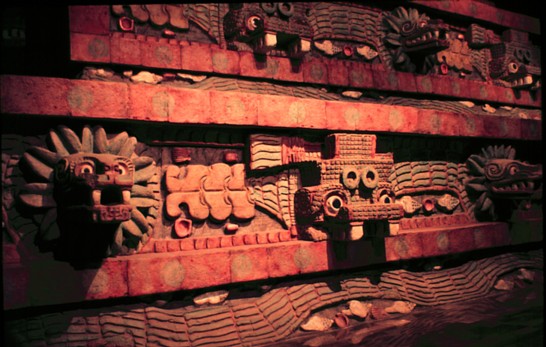
The Quetzalcoatl Pyramid facade has been partially recreated in the National Museum of Anthropology in Mexico City. Trace amounts of the original paints allowed for a full color recreation. |

An immense monolithic statue of Chalchiuhtlicue from Teotihuacan is housed in the Teotihuacan gallery of the Museum of Anthropology, Mexico City. |
|||||||
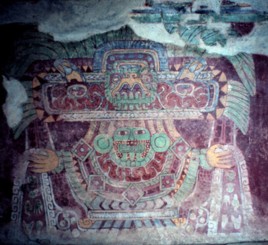
Vivid fresco murals also decorated the interiors of buildings. Several are recreated in the museum. |
||||||||
|
|
Many areas of the city center have several layers of ruins, preserving an older era of building below successive construction. |
|||||||
 A
wheeled toy. A
wheeled toy.
|
 The interpretation of the art, iconography and symbolism at Teotihuacan has remained elusive, or, where proposed, often there are conflicting interpretations. |
|||||||

Tepantila mural recreation. |
 |
|||||||
| Teotihuacan Mural Art: Assessing the Accuracy of its Interpretation
The Dresden Codex Lunar Series and Sidereal Astronomy Assessing Evidence of Geospatial Intelligence in the Americas
|
||||||||





|
Search the Web Search jqjacobs.net |
|
|
Return to the MESOAMERICAN WEB RING Page MESOAMERICAN PHOTO GALLERIES: Teotihuacan - - Chichen Itza - - Uxmal - - Palenque - - Izapa Stone Sculpture - - Artifacts I - - Artifacts II WORLD WIDE WEB HUBS BY THE AUTHOR: Rock Art - - Home Page - - Photo Galleries - - Art - - Web Design Your comments,
etc. are appreciated. Contact.
|