| The 2004 Election: Analyses, Summaries, Charts, and Spreadsheets |
The
2004 Ohio Presidential Election: Cuyahoga County Analysis
In a
subset of 166,953 votes, one of every 34 Ohio voters, the Kerry-Bush
margin Preface Simply put, Ohio votes were NOT all counted as cast. Many votes were miscounted, and Kerry votes were counted for Bush. Numerous questions have been raised about the fairness of the 2004 Presidential election in the United States of America (US). In this study I focus on one election issue, punch card cross-votinghow votes cast one way were counted other than as intended, as a vote for a different candidate or option. Punch card voting has been replaced and, with so many election issues, this most egregious of flaws—counting votes wrong—has seemingly been overshadowed by e-voting and reform concerns. I also focus on a particular region with one-tenth of the Ohio vote, Cuyahoga County, where recount crimes have detracted from miscounting the vote. The 2004 recount issue focused attention away from cross-voting. Cross-votes recount the same and, hence, are an entirely distinct issue. In 2000, the US post-election focus was on Florida, on fairness of punch card voting, on vote count accuracy, and on incomplete counting. In 2004, Ohio's failure to replace punch card voting with improved systems is just one of many issues raised with regard to the Ohio 2004 Presidential election. Other Ohio fairness, fraud, and irregularity issues include politicization of process, voter registration fraud, voter purging and suppression including racial discrimination and unfair voting machine distribution, the exit poll inaccuracy, electronic voting security, paperless e-voting, e-vote flipping, the high percentage of and unequal distribution of undervotes, uncounted provisional ballots, vote count secrecy, recount crimes and irregularities, and official loss of and/or destruction of evidence. This article and the appendices combine, with additional material, earlier versions cited in academic references. In a separate file, I present a 2004 Ohio Presidential Election Results Summary and various Ohio datasets. Seven-eights of voters
in heavily-Democratic Cuyahoga County,
more
than one of every eight
Download vote_switching.ppt featuring
highlights from the study.
The contents links allow readers familiar with some aspects of the issue to focus on specific topics. The subject is complex, and introductory material is conveyed throughout the topics and in the appendices. This topic required defining vocabulary and creating new notations. These are defined throughout the article and discussed in the appendix.
Miscounted votes in Ohio came to my attention via press coverage. An incident came to light due to very high returns for third-party candidates in several Cuyahoga County precincts:
"How many votes were switched?" should be an easy number to define, I initially surmised. Wrong-precinct voting occurred at a surprisingly high rate. Instead of immediate clear answers, trying to tally the miscounting led down a long path with many more questions, taxed my knowledge of statistics and quantitative methods, necessitated developing new methods, and produced unexpected findings of unfairness in the election process—all providing a political education my political science classes never even considered. The evidence raises suspicions about intentional manipulation of the election process directed at changing the outcome in favor of Bush. I soon wondered, "Were ballots fraudulently switched?" For Ohio punch card voting, accurate tally is dependent on precinct chain of custody, from giving the voter a ballot until central tabulation. Ballots must be cast and counted in their own precinct. Many votes were counted for the wrong candidate or ballot option, and a significant portion of the cross-voting resulted in Kerry votes tallied as Bush votes. The 2004 Presidential election hinged on the Ohio results. According to unadjusted exit polls, Kerry won Ohio. Instead, with a 3.35 percent difference between the tallies, the results gave the victory and the presidency to Bush. With these circumstances, evidence of miscounted voting and Kerry-to-Bush vote switching have particular importance in determining the actual intent of Ohio voters, the reasons for the exit poll discrepancy, and the validity of the 2004 US Presidential election result. Cross-voting also impacted other races. Analysis of past elections and other counties and races may reveal more punch card cross-voting. I present evidence of cross-voting and of how Kerry disproportionately lost votes to cross-voting. I report how ballot order combinations favored Kerry to Bush cross-voting. I present methods developed to determine how many votes were switched, miscounted, or not counted at all. I report the impact of cross-voting and present evidence of the degree of miscounted voting. Finally, statistical tests are applied to the data. Analysis of election results—because every respondent has been polled—is, largely, descriptive statistics, enabling robust statistical analysis without some margin of error problems of sample polling used in inferential statistics. |
|
The first question I tried to answer was, "How many votes were switched?" Cuyahoga County reported, for the 1432 of 1435 precincts included in this study, 1,003,435 registered voters cast 600,467 votes at precincts, 10.76% of the Ohio vote. Since John Kerry received 65.67 percent of these (394,354 votes), on average Kerry would lose two votes to wrong-precinct voting for every vote Bush loses. This, of course, assumes random distribution of ballot order combinations, cross-voting, and vote-switching in relation to candidate support and other variables. It also assumes ballots were counted in precinct as cast, not switched between precincts later to alter votes. With candidate support varying widely in precincts, where wrong-precinct voting occurs determines the ratio of lost votes and the proportion of vote-switching. The cases following illustrate the variable impact of wrong-precinct voting. Table 6 displays results for the most egregious of obvious cross-voting locations, Benedictine High School. Here major candidates were not collocated. Up to 215 people in precinct 1806 cross-voted for Kerry in precinct 1814, punching the third position using the precinct 1814 voting machines. Those 215 Kerry votes counted for Peroutka (K-p) due to the K-p ballot order collocation. Also, up to 164 Kerry voters from 1814 punched the first position, Kerry in precinct 1806. Those 164 ballots counted as Badnarik votes, the first position in precinct 1814. Meanwhile, Bush lost 10 votes to Peroutka in precinct 1814.
The Benedictine High School tally demonstrates how the number of votes lost to cross-voting is proportional to candidate support. The greater the candidate's support, the greater the negative impact of cross-voting. Kerry lost about 38 times more votes than Bush, 379 votes or 37% of his vote in this location, about 1/1,000th of his votes in the entire county. Kerry votes would increase by up to 60% without this cross-voting. In these precincts Kerry had 96% support, so 24 of 25 random cross-votes would be Kerry voters. Table 7 illustrates two precincts where Bush and Kerry votes can be switched by wrong-precinct voters punching the third position of the ballot order. Kerry voters from precinct 2908 punch the third position (K) on 2909 machines, in their precinct a Bush vote. These Kerry cross-voters cast a vote-switch between the major contenders—the one vote that counts twice.
Table 8 presents the voting results. The precinct 2909 Kerry cross-voters voting in 2908 tallied for disqualified (K-d) in their own precinct. Bush voters from precinct 2908 voting in precinct 2909 voted the second position, Badnarik (b) in their own precinct, while Bush votes from precinct 2909 vote-switch to Kerry in 2908.
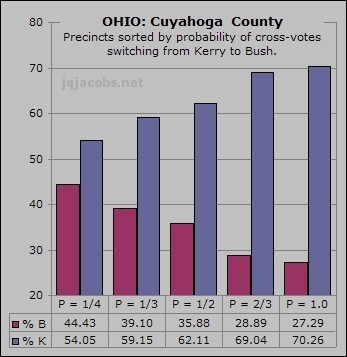
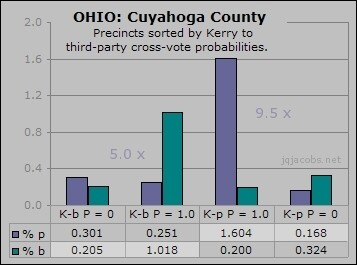
Conclusively, third-party "cast" votes average less than one vote per precinct. In all those precincts with zero probability of a Kerry cross-vote counting for Badnarik, Badnarik garnered a mere 0.20%, compared with 1.02% in precincts with a 1.0 probability of Kerry cross-votes counting for him, a five-fold increase. For Peroutka, the percentage jumps nearly ten-fold from 0.168 to 1.604. Figure 1 illustrates the pattern. Now, presumably 14 Bush voters in precinct 2908 cross-voted in precinct 2909, where punching the second candidate counted for Badnarik in their precinct. Bush probably lost 14 votes, 14 of the 15 votes counted for Badnarik.
Badnarik votes increase five-fold and Peroutka votes jump over nine-fold. Kerry-Bush switched-votes are not as readily apparent, obfuscated by higher percent returns, so this example employs hypothetical proportions. Assuming candidate support in the location is 2:1 and that an equal proportion of Kerry voters cross-voted, then 28 precinct 2908 Kerry voters would punch the third position in 2908 and mistakenly vote-switch to Bush. If in precinct 2908, Badnarik gained 14 Bush votes while 28 Kerry votes switched to Bush, the margin between Bush and Kerry changed by 42 votes in Bush's favor, a 17% shift. Comparing Table 8 and Table 9 illustrates how cross-voting hypothetically altered the Kerry's vote by an 11.67% drop, to 65.26% from 73.72%.
Of course, in a hypothetical scenario assuming random cross-voting, voters from 2909 also cross-vote. For these voters, the ballot order combination creates different results. In position 3, Bush voters cast votes counted for Kerry while Kerry cross-voters punch disqualified. The number of disqualified votes indicates the maximum number of Kerry cross-voters, up to 24. Assuming all 24 of the precinct 2909 disqualified votes are Kerry cross-voters and, once again, half as many Bush voters also cross-voted, Bush gets back his 12 votes and Kerry nets 12. Accounting for these cross-votes, precinct 2909 voting would have resulted as shown in Table 10.
For the two precincts, Kerry should have garnered 70.03%. Instead he received only 63.72%, a drop of 6.3%. Bush started with 25.7% and ended with 26.0%, or a gain of only 0.315%. The Kerry margin over Bush shrinks by 6.0%. But this scenario began using understated, after-cross-vote results to determine the Bush and Kerry voter proportions! There likely were actually 3 Kerry voters for every Bush voter, so for every 14 Bush cross-voters there should be about 3 times as many Kerry cross-voters. Our first order computation only used twice as many. Recalculating with the 3:1 voter ratio, the Kerry lead increases by 78 votes in the two precincts, a net impact of a 10.87% shift in the margin. The Ohio raw exit polls' disparity with the Kerry vote is 3.35%. By comparison, if a net 1.05% of Ohio Kerry votes switched to Bush, the election outcome was altered. The net impact of cross-voting is significant, especially with switched-votes. The degree of impact of cross-voting seen in this scenario and the third-party cross-voting above certainly brings into question the validity of the election results. The Euclid voting location, in Table 11 below, illustrates two-ballot-orders without Bush and Kerry collocation. Bush cross-votes count as d or p, Kerry cross-votes count as p or b. In precinct 3943, it appears Kerry lost up to 93 votes to Peroutka. Kerry is collocated with Peroutka, Bush with disqualified. There are no disqualified votes in precinct 3943, so no Bush voters cross-voted. If the ballot order in this case had instead switched Kerry votes to Bush votes, with only one party cross-voting, no direct evidence would exist of cross-voting at the location, excepting statistical evidence of course. In the light of such possible hidden vote-switching, this case is particularly alarming. It illustrates how vote-switching can be completely hidden, unrelated to minor candidate and non-vote results. Was vote-switching intended in this instance? Did someone switching ballots err, thinking this ballot-switch changed Kerry votes to Bush? And undetected at that! This instance forces the question, "How did one-party cross-voting occur?"
This location also forces the question, "Were up to 93 ballots switched to a different precinct after voting and before counting?" I do not know. Disparity of precinct populations (72 votes to 403) may have driven voters to empty machines in the smaller precinct. But why only Kerry voters? Did poll workers distinguish party affiliations and manipulate wrong-precinct voting? Or, did someone switch the ballots after the voting? If this case is not fraudulent, then Kerry lost up to 93 votes to Peroutka because, suspicious and improbable as it is, only Kerry voters in 3943 cross-voted. A smoking gun like this should cause an election irregularity investigation. Why this did not, and still does not, is a mystery. These examples evidence cross-voting and possible election fraud, and more evidence is interwoven in the following sections. The amount of cross-voting is expected to be random when accidental and unwitting, but if manipulated to alter the outcome, of course the expectation is that it will be non-random and biased. Precinct level analysis indicates cross-precinct voting is not randomly distributed, producing one more mystery not easily answered, especially not from data, "Why is cross-voting unevenly distributed?"
Cross-voting changes the results substantially. Cross-voting favors the candidate with the least support. Not every ballot order combination switches major candidate votes. Every switched-vote 'counts' twice! |
|||||||||||||||||||||||||||||||||||||||||||||||||||||||||||||||||||||||||||||||||||||||||||||||||||||||||||||||||||||||||||||||||||||||||||||||||||||||||||||||||||||||||||||||||||
|
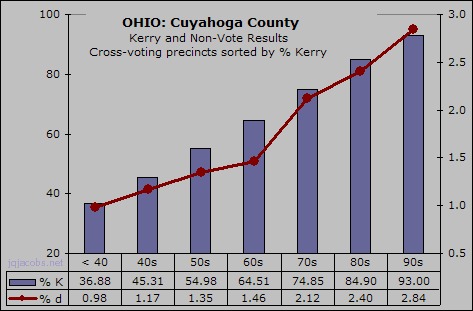
Cuyahoga non-votes included any candidate votes not counted (i.e. hanging chads, other spoilage) and no vote cast for president. In some states, the undervote percentage is well below one percent. Ohio recorded near the highest rate in 2004. Ohio's state-wide non-vote rate for e-voting was near normal, at 0.76% compared to 1.90% for punch card voters. However, precinct level analysis indicates that many punch card precincts had normal non-voting percentages. Non-voting distribution is skewed rather than random and correlates with Kerry support. Figure 3 illustrates the non-vote results for precincts sorted by the level of Kerry support. The non-vote rate is more than three times the normal expectation in precincts with highest Kerry support. Suspiciously, where cross-voting reduces Kerry's vote the most, the non-vote rate is highest. The rate jumps significantly in precincts which reported more than 70% Kerry support.
Figure 4 displays Bush and non-votes percentages for all Cuyahoga precincts with over 3.6% non-votes. This sort represents 11.0% of the ballots cast and 27.7% of the non-votes. Non-voting is over four times normal in these precincts. Nearly all have over 75% Kerry support, many have over 90% Kerry support. Bush's mean tally in this group is 10.25%.
In Cuyahoga County, Kerry lost a very high, non-random proportion of the uncounted votes. This cross-voting/undercounting concentration where it lowers Kerry's tally the most raises suspicion of irregularities and presents yet another mystery, "Why is undervoting concentrated in locations with the highest Kerry support?" It appears Kerry was robbed of votes! |
|
Multiple ballot order locations constituted 87.6% of the Cuyahoga precincts. Using standard probability (P) notation, the probability that a voter could cross-vote, based on actual number of ballots cast, was P = 0.875. Seven of eight ballots were cast at precincts with possible cross-voting, and over 525,000 votes were recorded, 9.2% of Ohio's vote reporting 64.6% Kerry support after the cross-voting. The Cuyahoga County multiple ballot order locations represent 12.75% of Ohio's reported Kerry votes. In summary, seven-eights of voters in Cuyahoga County—including more than one of every eight Ohio Kerry voters—could have voted at an adjacent precinct using the wrong ballot order. Of the 525,172 possible cross-voters, 260,988 could vote-switch Kerry-Bush at an adjacent precinct. I wondered, "How many Kerry votes were switched to Bush?" Probability calculations are unabashedly simple. Flip a coin with two sides, the probability that one side will be up is 1/2. For two mutually exclusive events such as heads or tails, P = 0.50. Given five vote options with more precincts than ballot orders at some locations, the probabilities are more complex and yet readily determined. Table 12 presents the random probabilities of major candidate collocation. Of course, at individual locations, the precinct probabilities differ according to which ballot orders are combined with which others. Locations with three precincts and two ballot orders, for example, can have two precincts that switch Kerry votes to Bush votes and only one switching Bush votes to Kerry votes, hence the vote-switching probabilities are K-B P = 2/3 or B-K P = 1/3. Conversely, where voters can wrong-precinct vote using the same ballot order as their own precinct, the probability that wrong-precinct voters will cross-vote is reduced.
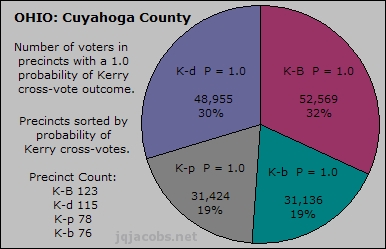
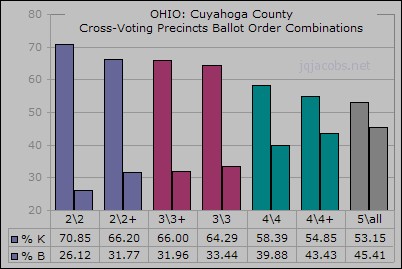
When flipping a coin, we are assured that the number of heads and tails are equal. The odds are 50/50, heads or tails, for 100 coin tosses ONLY if both heads and tails are on the coin 100 times! With dice, the odds are one of six, etc. Cuyahoga County election officials decided how many and which candidates were collocated at which locations, who appeared together for each roll of the dice, how many sides the dice had, even which candidate appeared on several sides. A complex pattern of skewed probabilities emerged from analysis of the actual ballot order combinations. Initial analysis revealed that Kerry received 8.9% fewer votes at locations where voters could cross-vote. Further inquiries demonstrated that ballot-order combinations, but not ballot orders, had a surprising correlation to the results. When all precincts are sorted by the five ballot orders, the Kerry vote percentage varies normally, from 65.3 to 66.1 percent. That range increases significantly, varying from 60 to 77 percent, when all precincts are sorted instead by ballot order and precinct combinations. The next section addresses this variation in relation to precinct and location cross-vote outcome probabilities. Table 13 and Figure 5 illustrate the distribution of cross-voter subsets using percentage of the whole. Almost all voters had non-random probabilities of cross-vote outcome. The largest subset, 2\2 locations with 27.7% of cross-voters, always has 1.0 probability of location cross-vote outcome since only one other candidate can be in the same ballot position. Over 3/4ths of potential cross-voters, 77.6%, voted at locations with only one or two possible cross-vote outcomes. Only 1.7% of cross-votes, those at locations with five precincts and five ballot orders, had equal probability (P = 0.25) a cross-vote counted for one of four other candidates.
| |||||||||||||||||||||||||||||||||||||||||||||||||||||||||||||||||||||||||||||||||||||||||||
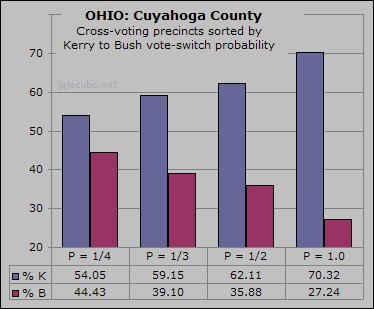
| Cross-vote outcome varies by precincts rather than locations, therefore I defined cross-vote outcome probabilities for each precinct. Analysis with precincts sorted by cross-vote probability reveals the impact of cross-voting—both by accounting for how cross-votes tally and by distinguishing vote-switching. I codified wrong-precinct voting using Cuyahoga's majority voter, the Kerry voter. Hence, the short-hand notation K-b, K-B, K-d, and K-p represents the four cross-votes, and K-K represents wrong-precinct voting or ballot switching with the same ballot order. For example, K-B P = 1.0 represents Kerry-Bush vote-switch probability equals 1.0. The datasets use this notation and display analyses of probability sorted subsets. Table 14 presents probabilities of vote-switching at precincts with collocated major candidates. As is readily seen, when the number of ballot orders at the location increases, the vote-switching probability decreases. Random cross-voting has a certain outcome only at locations with two ballot orders. Cross-vote outcome can also be certain when non-random, if the voter is directed to cross-vote or when ballots are precinct switched after votes are cast. At the central tabulation site, these location cross-vote limitations do not apply of course, since any two precinct's ballots can be switched. Analysis using location probability subsets identifies location related chain of custody error.
At locations with more precincts than ballot orders, some wrong-precinct votes count as intended. Table 15 presents cross-vote probabilities for the ballot order\precinct (BO\P) subsets. The + notation, 2\2+, 3\3+, etc., represents locations with more precincts than ballot orders. The greater the number of precincts, the less likely the wrong-precinct vote counts as intended. Given the subset probabilities in Tables 14 and 15, reconsider the subset population distribution in Table 13. Ballot order subset distribution favors the probability of vote-switching. The two largest groups, the 2/2 and 3/3 locations—over half the population, have P = 1.0 cross-vote probability—meaning their K-K P = 0.0.
In Cuyahoga County 2004, voters were rolls of the dice, and each vote was an event—one roll of the dice with alarming odds a vote counted opposite the voter's intention. Actual voter numbers in each probability subset, not the precinct averages, define precise overall probabilities and size disparity skews even random cross-vote outcome probability. Table 16 presents 2\3 locations sorted by Kerry-Bush vote-switch probability. One striking statistic in this small subset is the disproportionate sizes of the precincts. The ballot order with a 1.0 probability that Kerry cross-votes tally for Bush was assigned to precincts on average with 50% more voters.
If K-B P = 1.0
ballot orders are assigned to larger precincts, Table 17 presents county-wide cross-vote outcome probabilities. The official results indicate 39,388 of 525,172 Kerry wrong-precinct voters would vote as intended, so overall K-K P = 0.075. Two specific pairings of cross-votes, Kerry with disqualified and Badnarik with Peroutka, is clearly illustrated by the probabilities. Figure 1 and Table 2 also illustrate probability pairing patterns (further discussed below). In Table 17 the skewed probabilities of the 2\2 subset reflect the overall population size disparities seen in Figure 6 below. The ballot orders were combined such that Kerry and Bush are collocated most often. Significantly more ballot combinations switch Kerry cross-votes to Bush and to disqualified than to the third party candidates. In the largest subset, the 2\2 subset with cross-vote outcome P = 1.0, the imbalance is most exaggerated with K-B skewed from the random expectation of P = 1/4 to P = 1/3.
Outcome probabilities of wrong-precinct voting favor Kerry to Bush vote-switching.
An important aspect of descriptive statistics is initial examination, assessing basic properties of the data. Finding natural divisions or subsets in a dataset enables comparative analyses. Pairing is an important analytic tool. For example, pairing allows survey of whether wives and husbands agree rather than just whether men and women agree. As seen in the wrong-precinct voting examples (Tables 8 to 11), when Kerry cross-votes switch to Bush for one precinct, an adjacent precinct cross-votes Kerry to disqualified. In like manner, Kerry cross-votes to Badnarik and to Peroutka are paired. These pairings determine cross-vote outcome patterns, and examination of the vote results for evidence of the patterns can measure cross-voting and vote-switching. Table 18 presents a comparison between random probability and the actual K-B and K-b cross-vote probability for the major ballot order and precinct combinations. Note the number of voters in each subset and the relation of the voter numbers to the probabilities, number of voters correlates positively with K-B P (0.47) and negatively with K-b P (-0.52). The pattern of ballot order combinations favors the K-B vote-switch probability. The only subset with a skew slighting vote-switching to Bush is locations with 2 ballot orders and more precincts. Due to cross-vote outcome pairing, the K-d and K-p probabilities closely parallel K-B and K-b respectively.
| |||||||||||||||||||||||||||||||||||||||||||||||||||||||||||||||||||||||||||||||||||||||||||||||||||||||||||||||||||||||